

An education designed for the person your child will become.
Every parent wants their child to grow into a confident, capable, and compassionate adult.
The question is how.
At AIA Montessori, our answer comes from a method that has spent more than a century studying how children naturally learn, develop independence, and build confidence in themselves.
Rather than asking children to fit a predetermined system, Montessori begins with the child. Their curiosity. Their interests. Their developmental readiness. Their unique path of growth.
The result is an education that helps children do more than master academic skills. It helps them become self-directed learners, thoughtful problem-solvers, and capable young people who are prepared to thrive in an ever-changing world.
Every classroom at AIA is built upon these timeless Montessori principles.
A physician who changed the way we understand learning.
Long before Montessori became a worldwide educational movement, Dr. Maria Montessori was a physician observing children with the eye of a scientist.
What she noticed challenged many assumptions about education. Children were naturally curious. They wanted meaningful work. They were capable of far more independence than adults often assumed. When given the right environment, they didn’t need constant rewards, reminders, or direction to learn.
They wanted to learn.
Rather than creating a system that asked children to adapt to school, Montessori created a school designed around the developmental needs of children.
More than a century later, that same insight continues to guide every classroom at AIA Montessori.
While the world has changed dramatically, children have not.
They still learn best through curiosity, purpose, movement, exploration, and meaningful relationships.
Five principles that help children thrive.
The Prepared Environment
Every material has a home, sized and placed for the child, encouraging independence from the moment they walk in.
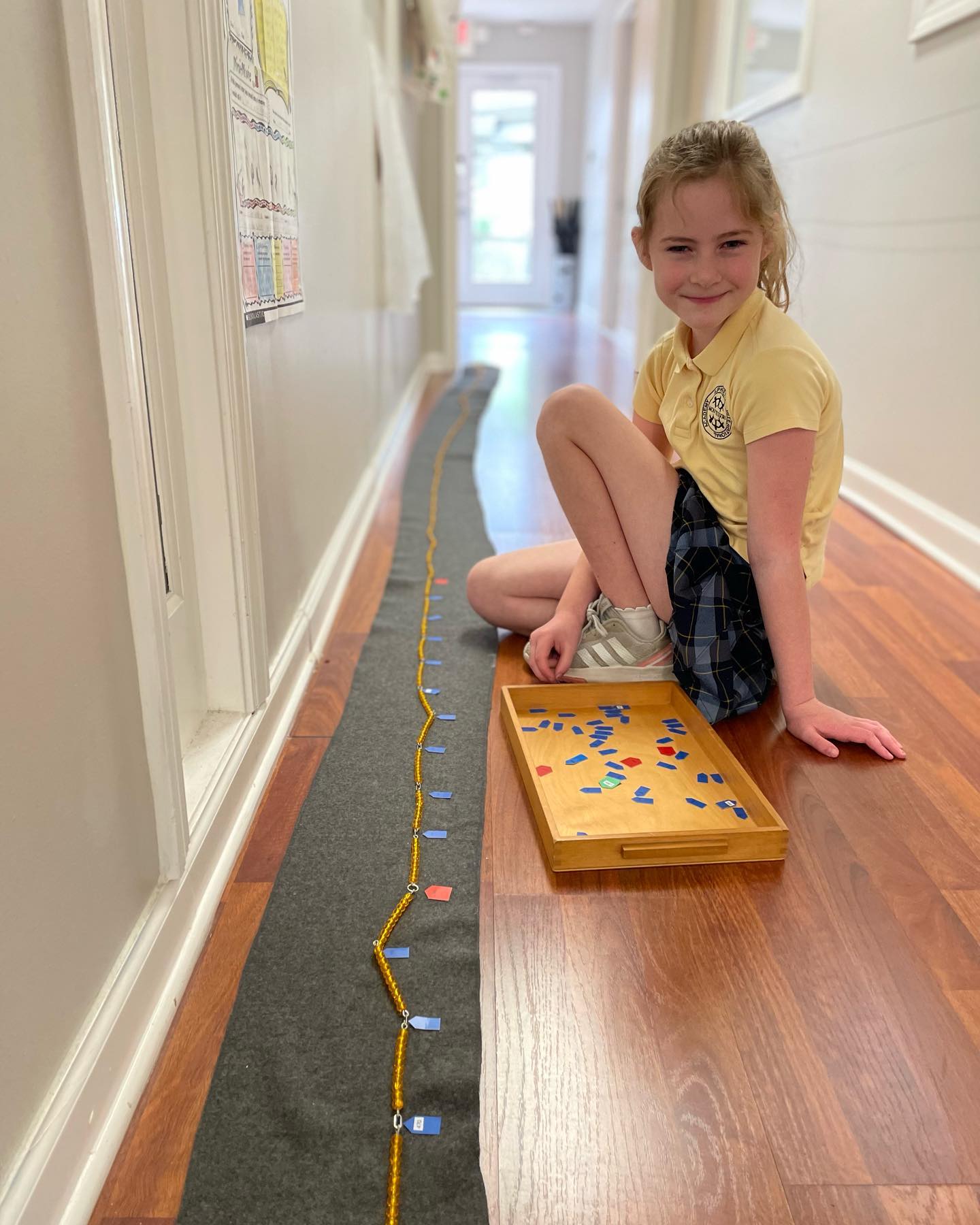
Hands-On Materials
Carefully designed materials allow children to experience abstract ideas concretely, supporting understanding before and alongside symbolic and verbal work.
Multi-Age Classrooms
Three-year age spans let younger children learn by watching older peers, and older children deepen understanding by mentoring.
Uninterrupted Work Time
Long, unhurried work periods let children follow their own curiosity to real depth and concentration.
Respect for the Child
Guides observe before they intervene, treating every child as a capable, curious individual, not a student to be managed.
“The essence of independence is to be able to do something for one's self.”
Why Montessori classrooms stay together for three years.
Many schools organize children into single-grade classrooms that begin and end each year. Montessori takes a different approach.
Montessori classrooms are intentionally designed as multi-year communities. Children remain together for approximately three years, creating a natural progression of growth, belonging, and leadership.
In the early years, children observe, explore, and build foundations. They learn from older classmates, gain confidence through repetition, and gradually become more independent.
Then something remarkable happens.
The child who once looked up to the older students becomes one of them.
In the final year of the cycle, children step into leadership roles within the classroom. They mentor younger classmates, model lessons and routines, and discover that helping others learn deepens their own understanding. What once felt challenging becomes second nature. What once required guidance becomes something they can confidently do on their own.
This is why the final year of a Montessori cycle is so important. It is not simply another year in the same classroom.
It is the year when confidence becomes leadership.
Children leave with stronger academic skills, greater independence, and a deeper sense of responsibility. They have not only learned from their community. They have contributed to it.
Montessori was never designed as a one-year experience. It was designed as a journey of growth, belonging, and leadership.
Raising lifelong learners.
Every parent hopes their child will grow into a confident, capable adult who can think independently, solve problems, adapt to change, and pursue their goals with purpose.
At AIA Montessori, that is exactly what we’re working toward.
The world our children will inherit is changing faster than any generation before them. New technologies, new careers, and new challenges will continue to emerge throughout their lives. Success will depend not only on what they know, but on their ability to keep learning, keep growing, and confidently navigate the unknown.
That is why Montessori education looks different.
Rather than teaching children what to think, Montessori helps children learn how to learn.
The adults in our classrooms are called guides because their role extends beyond delivering lessons. Montessori guides carefully observe each child’s interests, strengths, readiness, and potential. They introduce lessons at the right moment, provide encouragement and challenge when needed, and gradually step back as independence grows.
Over time, a quiet transformation begins.
Children begin to trust themselves.
They learn how to concentrate deeply. They learn how to make decisions. They learn how to recover from mistakes. They learn how to seek answers, ask better questions, and take ownership of their learning.
Most importantly, they discover that they are capable. Not because an adult told them they were capable, but because they experienced it for themselves.
The goal isn’t for children to become dependent on the adult in the room.
The goal is for children to discover something far more powerful:
“I can do this myself.”
That belief becomes confidence. Confidence becomes independence. Independence becomes leadership.
And leadership becomes a life filled with curiosity, purpose, and the courage to embrace new opportunities.
This is why Montessori uses the word guide.
The greatest educators don’t create students who need them forever.
They help children become lifelong learners who are ready to adapt, contribute, and thrive in a changing world.
Our goal is not simply to prepare children for the next grade. Our goal is to help them become capable, confident, self-directed learners who are truly ready for the world.
“The greatest sign of success for a teacher is to be able to say, ‘The children are now working as if I did not exist.’”
Want to go deeper on the method?
These organizations are excellent starting points if you'd like to learn more about Montessori education before your visit.
American Montessori Society
A leading Montessori membership organization offering research, teacher credentialing, and family resources.
Visit AMS →Association Montessori Internationale
Founded by Maria Montessori herself, AMI maintains international standards for authentic Montessori training.
Visit AMI →International Montessori Council
A global community connecting Montessori schools and educators. AIA is a proud member.
See Our Affiliations →Still have questions about Montessori?
We wrote answers to the questions families ask most, from academic rigor to how progress is measured without grades.