

Why Montessori Doesn’t Rely on Grades, Tests, and Homework
One of the first things parents notice about Montessori education is what isn’t there. Fewer worksheets. Fewer tests. Fewer grades. Often, less homework.
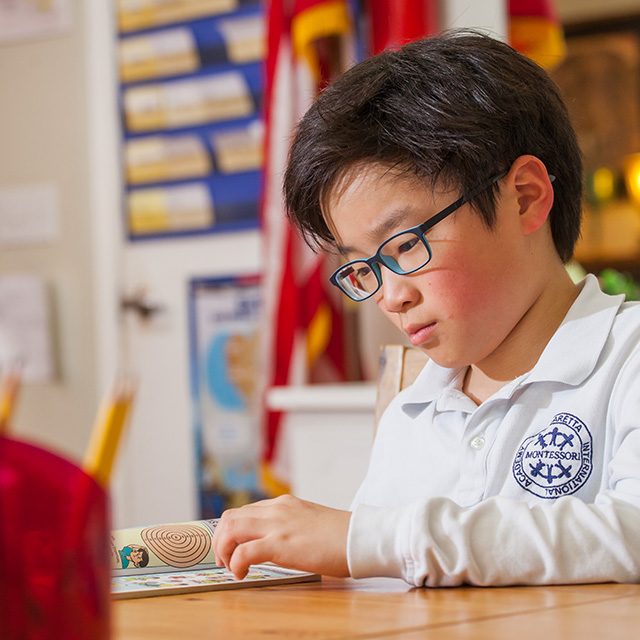
For families who grew up in traditional schools, this can raise an important question. If children are not getting grades and taking frequent tests, how do we know they are learning?
The answer begins with understanding what Montessori education is designed to accomplish.
Montessori is not focused on helping children learn for the next test. It is focused on helping children learn for life.
Learning versus performing
Traditional education often relies on grades and tests to measure how much information a student can recall at a specific moment in time.
While assessments can provide useful information, they do not always tell the full story. A child may earn a high score after memorizing information for a test and forget much of it a week later.
Montessori takes a different approach. The goal is not temporary performance. The goal is lasting understanding.
Children are encouraged to explore concepts deeply, apply what they learn, and demonstrate mastery over time rather than simply preparing for the next exam.
How Montessori measures progress
Montessori classrooms are highly intentional learning environments.
Guides carefully observe each child, track progress, introduce new lessons, and document growth throughout the year. This ongoing assessment provides a much richer picture of a child’s development than a single test score.
A Montessori guide knows:
- Which concepts a child has mastered
- Which skills are still developing
- Where additional support may be helpful
- When a child is ready for new challenges
- How a child approaches problem-solving and independent work
Rather than receiving feedback only a few times each year, students receive guidance every day.
The problem with grades
Grades can be useful, but they can also create unintended consequences.
Children may begin asking what they need to do to earn an A, instead of what they can learn from the work in front of them.
When the focus shifts toward earning points, stickers, or grades, learning itself can become secondary.
Montessori seeks to nurture something different: intrinsic motivation.
Children learn because they are curious. Because they want to understand. Because solving problems is rewarding. Because learning is meaningful.
These motivations tend to last far longer than external rewards.
What about homework?
Parents often associate large amounts of homework with academic rigor. However, research has shown that more homework does not necessarily lead to better learning, particularly for younger children.
Montessori recognizes that childhood should include more than academics. Children need time for family, play, reading, creativity, outdoor exploration, and rest.
The Montessori work cycle allows students to accomplish significant learning during the school day through focused, uninterrupted work periods.
As children grow older, responsibilities naturally increase and independent projects become more common. The goal is always purposeful work rather than homework for homework’s sake.
Developing lifelong learners
When children become dependent on grades, tests, and rewards, they often learn to work for external approval.
When children develop curiosity, responsibility, and self-motivation, they learn how to direct their own growth.
Montessori education is designed to build these habits from an early age. Students learn to:
- Reflect on their progress
- Set goals
- Evaluate their own work
- Persevere through challenges
- Take ownership of their learning
These skills often become more valuable than any individual grade.
Preparing children for the future
The world our children will enter values far more than memorization. Success increasingly requires critical thinking, creativity, communication, collaboration, adaptability, and problem-solving.
Montessori classrooms cultivate these skills every day.
Students learn how to think, not simply what to think. They learn how to ask questions, pursue answers, and continue learning long after they leave the classroom.
What this looks like at AIA
At AIA Montessori, our guides continuously observe, assess, and support each student’s growth.
Families receive meaningful feedback about academic progress, social development, independence, and classroom engagement.
Rather than reducing a child to a single letter grade, we strive to understand the whole child.
Our goal is not simply to help students succeed this year. Our goal is to help them become capable, confident learners for life.
The bigger picture
Grades, tests, and homework are tools. They are not the purpose of education.
The true purpose of education is to help children develop understanding, character, confidence, and a lifelong love of learning. Montessori education keeps that purpose at the center of everything we do.
Because what matters most is not what a child can remember for tomorrow’s test. It is what they will carry with them for the rest of their lives.
Questions families ask us.
Do Montessori students ever take tests?
Yes. Depending on age and program level, students may complete assessments and evaluations. However, testing is one tool among many rather than the primary measure of learning.
How do parents know if their child is progressing?
Through conferences, progress reports, classroom observations, student work, and ongoing communication with guides.
Will my child be prepared for traditional schools later?
Yes. Montessori students develop strong academic foundations along with independence, responsibility, and problem-solving skills that support successful transitions.
Why doesn't Montessori focus on grades?
Montessori emphasizes mastery, understanding, and intrinsic motivation rather than external rewards alone.
Families throughout Alpharetta, Johns Creek, Milton, Cumming, Suwanee, and surrounding communities often ask these questions as they explore Montessori education. At AIA Montessori, we encourage families to visit our classrooms and see Montessori learning in action.
About AIA Montessori
AIA Montessori is a nonprofit Montessori school in Alpharetta, Georgia, serving children from 18 months through Grade 8. Since 1981, AIA has helped children grow into confident, capable, and compassionate learners through authentic Montessori education.
Related articles.
Is Montessori Academically Rigorous?
Mastery over memorization, and where the rigor actually lives.
Do Montessori Children Really Choose Their Own Work?
What freedom within limits really means in a Montessori classroom.
Why Montessori Classrooms Are Multi-Age by Design
Why children of different ages learn better together.
Learning measured by more than what children know.
Visit AIA Montessori and experience a classroom where progress is measured not only by what children know, but by who they are becoming.
Book a Tour