


Finding Our Rhythm: Preparing the Environment for More Peaceful Mornings
By Sarah Prosser, Head of School
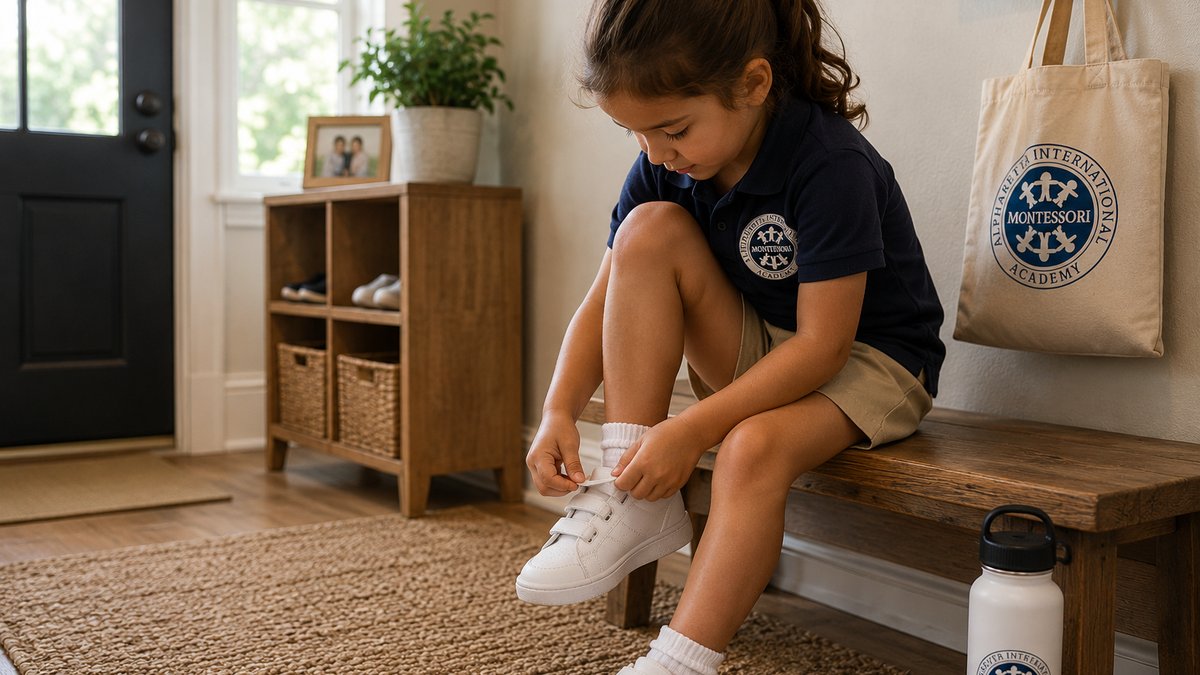
The beginning of a new school year brings a return to familiar rhythms: earlier bedtimes, school clothes, lunches, school bags, and getting everyone out the door on time. Even in the most organized household, mornings can quickly become a chorus of reminders:
“Did you brush your teeth?”
“Where are your shoes?”
“Get your school bag.”
“We need to leave!”
For children, too, the transition from the slower rhythms of summer to the expectations of a school morning can take time.
In a Montessori classroom, when something is not working smoothly, our first instinct is not simply to ask, How can we get the child to do this? We also look carefully at the environment and ask, What can we change to help the child be successful?
It is an approach that can be just as useful at home.
The prepared environment
One of the foundational ideas in Montessori education is the prepared environment.
Montessori guides devote considerable thought and time to preparing their classrooms. Materials are carefully chosen and arranged. Everything has a consistent place. Furniture and tools are accessible to the children who use them. There is order and predictability.
This preparation has an important purpose: it allows children to become increasingly independent and self-reliant.
In the classroom, the materials themselves form an important part of the curriculum. Once a child has received a lesson or presentation on a material, they generally do not need to ask an adult each time they want to use it. If the material is available to them on the shelf, they know where to find it, how to use it, and where to return it when they are finished.
The environment quietly communicates: You know what to do. You are capable of doing it.
That same principle can transform routines at home.
Prepare the environment, not just the child
Consider getting dressed in the morning.
If a young child’s clothing is hanging high in a closet, the shirt they need is difficult to reach, and an adult has to make every decision, getting dressed necessarily requires a great deal of adult involvement.
What if we prepared the environment differently?
The night before, a parent might offer a choice of three school shirts: white, blue, or yellow. The child chooses one, and the clothes for the next morning are placed on a chair or hung somewhere within reach.
There is choice, but not unlimited choice.
This is what we often call freedom within limits in Montessori. The adult establishes an appropriate boundary: These are the choices that work for school tomorrow. Within that boundary, the child has genuine agency: I choose the blue shirt.
The details will look different at different stages of development. A toddler might help pull up their pants or carry pajamas to the hamper. A Primary-aged child may be able to dress largely independently when clothing is accessible and manageable. An Elementary child can assume more responsibility for gathering belongings and preparing for the day. An adolescent can increasingly manage their own preparation and time.
The expectations change as the child develops. The principle remains the same: instead of doing for children what they are capable of doing themselves, we create the conditions that allow them to succeed.
Predictability supports independence
Think about how much of our own independence relies on knowing where things are and what happens next.
Children benefit from that same predictability.
Shoes have a home. The school bag has a home. Lunchboxes go in the same place. The steps of the morning generally happen in the same sequence.
For younger children, that sequence might even be made visible with simple pictures: get dressed, eat breakfast, brush teeth, put on shoes, get school bag.
When the environment provides these cues, the parent no longer has to be the morning reminder system. The environment and the routine begin to carry some of the responsibility.
There is also an important shift that can happen as children become more capable. Instead of an adult spending the entire morning directing the child’s routine, parent and child can begin to see themselves as members of the same household, each with responsibilities.
You have things to accomplish in the morning. Your child does, too.
Some parts of the routine may happen together. Others can increasingly belong to the child: While you get dressed and brush your teeth, I’m going to get ready. Then we’ll meet in the kitchen for breakfast.
Of course, expectations must always be developmentally appropriate. Independence does not mean withdrawing support. It means noticing when help is truly needed, and when a child may be ready to do a little more.
Independence takes time
There is one essential part of the prepared environment that cannot be organized into a basket or placed on a lower shelf: time.
Children learning to do things for themselves will often do them more slowly than an adult would.
We can put on the shoes, zip the jacket, find the water bottle, and pick up the school bag much faster. When our schedule has no margin, it is easy to step in and do for children what they might have done themselves simply because we need to get out the door.
Whenever possible, leaving a little extra time is part of preparing the environment, too.
This does not mean every morning will be peaceful or perfectly organized. Real families have missing shoes, spilled milk, tired children, forgotten lunches, and days when everyone simply needs to get moving.
Montessori at home is not about creating a perfect household. It is about creating opportunities for children to practice becoming capable.
Solve problems when everyone is calm
Even the best routines sometimes stop working.
Perhaps getting dressed has become a daily struggle. Maybe the school bag is repeatedly forgotten. Perhaps an older child is always running upstairs for one last thing when everyone else is ready to leave.
The moment when everyone is frustrated and you needed to leave five minutes ago is rarely the best time to solve the problem.
Instead, return to it later, during a quiet moment of connection or perhaps at a family meeting:
“Our mornings haven’t been feeling very good lately. I’ve noticed we’re both getting frustrated about getting ready. What do you think is making it difficult?”
Children can offer remarkably practical solutions when they are invited into problem-solving rather than corrected in the heat of the moment.
Maybe the shoes need a different home. Maybe the school bag should be packed the night before. Maybe choosing clothes in the morning takes too long.
The question changes from Why can’t you ever remember? to What could we change so this works better?
This, too, reflects the work of the Montessori guide: observe carefully, adjust the environment, model what is needed, and give the child another opportunity to practice.
Bringing it home
As your family settles into the rhythm of a new school year, take a fresh look at your morning environment.
A phrase often associated with Montessori captures the child’s drive toward independence beautifully: “Help me to do it by myself.”
You do not need Montessori materials or a perfectly organized home to honor that request.
Sometimes Montessori at home looks remarkably ordinary: a blue shirt waiting within reach, shoes in the same basket every morning, a school bag packed the night before, and enough time for a child to work at a zipper before we reach over and do it for them.
These may seem like small things. But each successful experience tells a child something important:
You belong here. You know what to do. I trust you, and I believe you are capable.
As you think about your family’s mornings.
- What does your child need to be able to reach independently?
- What items could have a more consistent home?
- What could be prepared the night before?
- Where could you offer more freedom within appropriate limits?
- What is your child capable of doing that you may no longer need to do for them?
Coffee & Chat with Sarah Prosser.
This month’s article is the focus of our next Coffee & Chat on Wednesday, August 19 at 9:00am. Join us as we discuss practical ways to support independence, reduce morning stress, and bring Montessori principles into everyday family life.
Add It to Your Calendar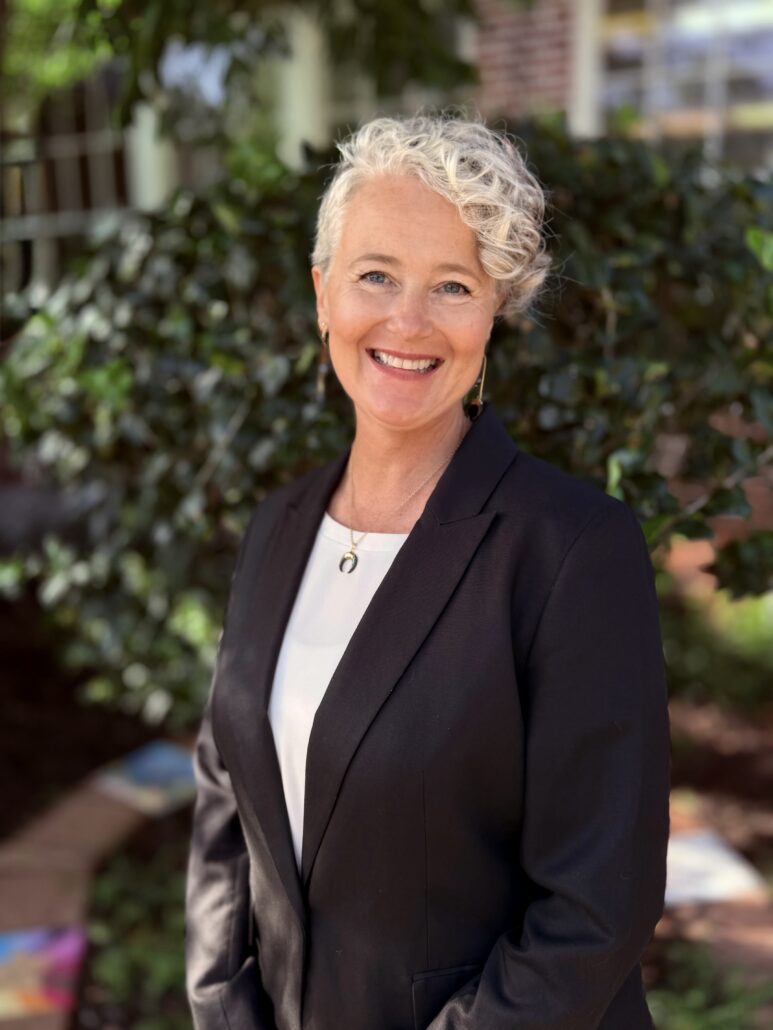
Sarah Prosser, Head of School
Sarah brings extensive Montessori leadership experience, a deep respect for the child, and a strong commitment to partnership with families. She writes a monthly article for the Parent Education Center and hosts Coffee & Chat gatherings throughout the year.